Your cart is empty
Tax included and shipping calculated at checkout

Cart Error
Drawer menu
Your cart (0)
Tax included and shipping calculated at checkout

Rhuddlan Castle is a Cadw-run Edwardian castle above the River Clwyd, with a free car park right outside the gate, a visitor centre, and an admission charge. Allow at least an hour, longer if you add Twthill and the town. Here is what you need to know before you go, from my own visits in 2026.
Yes. Rhuddlan is one of the most rewarding castles on the North Wales coast, and one of the easiest to visit. The twin-towered gatehouses still stand tall above the river, the moat is one of the biggest dry moats Cadw looks after, and the views across the Vale of Clwyd are superb. The best parts of a visit are the castle itself and those views, and the small town around it adds two more stops that most visitors miss: the Norman motte at Twthill and the old building on the High Street where Edward I is said to have held his parliament.

The castle stands on Castle Street in Rhuddlan, Denbighshire, beside the River Clwyd, about three miles from the sea. The postcode for the castle and visitor centre is LL18 5AB. By road, Cadw recommends approaching Rhuddlan on the A525 or the A547. Use the map below for directions.
Parking is easy. There is a free visitor car park immediately outside the castle, with room for about 25 cars, two electric vehicle charge points (charges apply) and bike storage. On a busy summer weekend it can fill up, but the town centre is only a few minutes' walk away if it does.
Rhuddlan is not so easy without a car, but it can be done. Buses stop about 250 yards from the castle: services 35 and 36 run between Rhyl, Rhuddlan and Prestatyn, and service 51 runs between Denbigh and Rhyl. The nearest railway station is Rhyl, about four miles away. National Cycle Network Route 84 passes about 300 metres from the castle. For times, check Traveline Cymru before you travel.
These are Cadw's published times and prices, checked on 17 October 2026. They change, so always check the Cadw Castell Rhuddlan page before you set off.
Booking online saves 5%, and Cadw also offers £1 tickets for people on Universal Credit and some other benefits. I visit as a Cadw member, which gets you into every Cadw castle for free. If you plan to see several castles in a year, membership quickly pays for itself.
Cadw has done a great deal to make Rhuddlan accessible, and rates the terrain as Level 1, its easiest grade. Much of the site can be reached by wheelchair, but the walls and towers clearly cannot. A few things to know:
If you have specific access needs, Cadw's Rhuddlan access information is worth reading first.
Rhuddlan was the first of the concentric, or "walls within walls", castles designed for Edward I by Master James of St George. Even in ruin, the plan is easy to read on the ground:


In summer there is a grassy bank by the castle that makes a lovely spot for a picnic, with a view to match. Bring something to sit on.
The river below the castle is part of the story. Rhuddlan sits several miles inland, and the meandering Clwyd was too shallow and winding for Edward's supply ships. Between 1277 and 1280, hundreds of ditch-diggers, many of them fenmen from Lincolnshire, cut the Forfardyke, a new, straighter and deeper channel of about two miles, so that ships could sail from the sea up to the castle. A walk along the riverbank gives you a feel for the scale of the work.

Twthill is the earlier Norman motte, raised by Robert of Rhuddlan in 1073, two centuries before Edward's castle. It stands a short walk south of the castle and is free to visit. It is easy to reach on foot, but the mound itself is very steep, so wear sensible shoes. The climb is worth it to see where Rhuddlan's first castle stood.
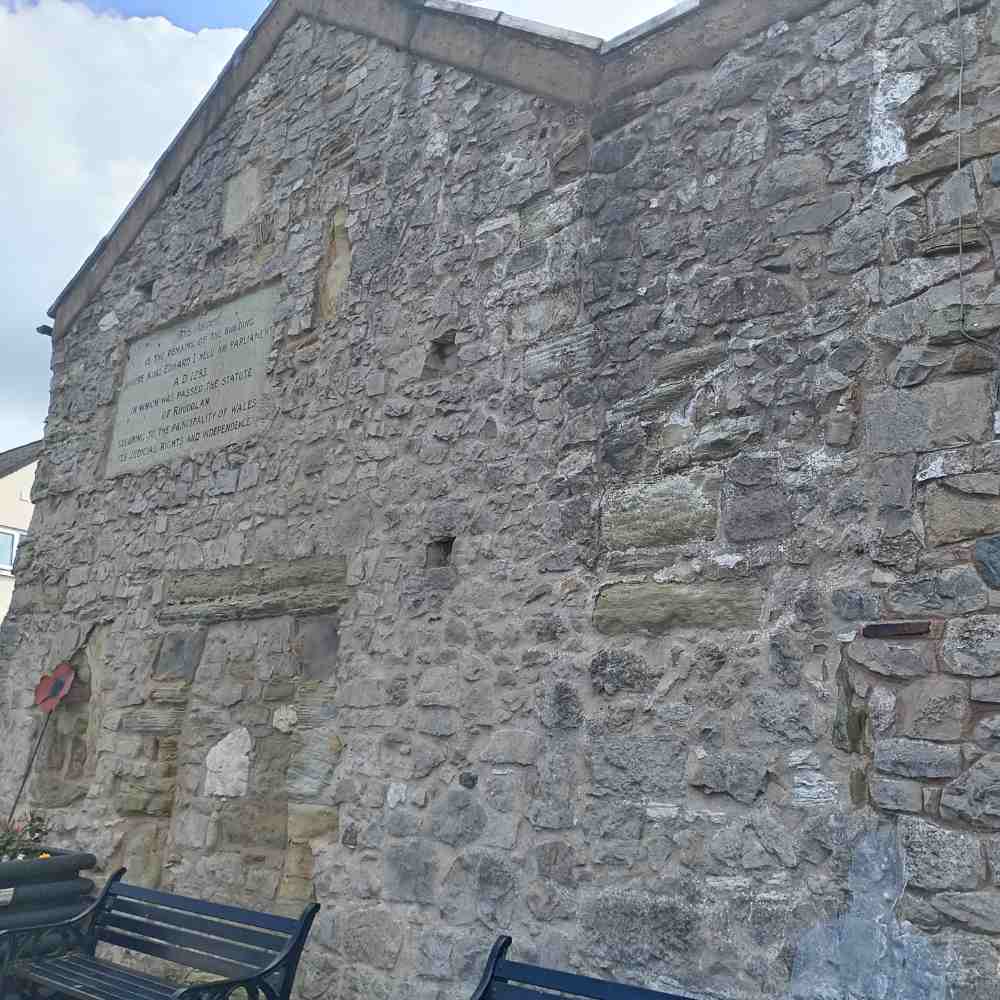
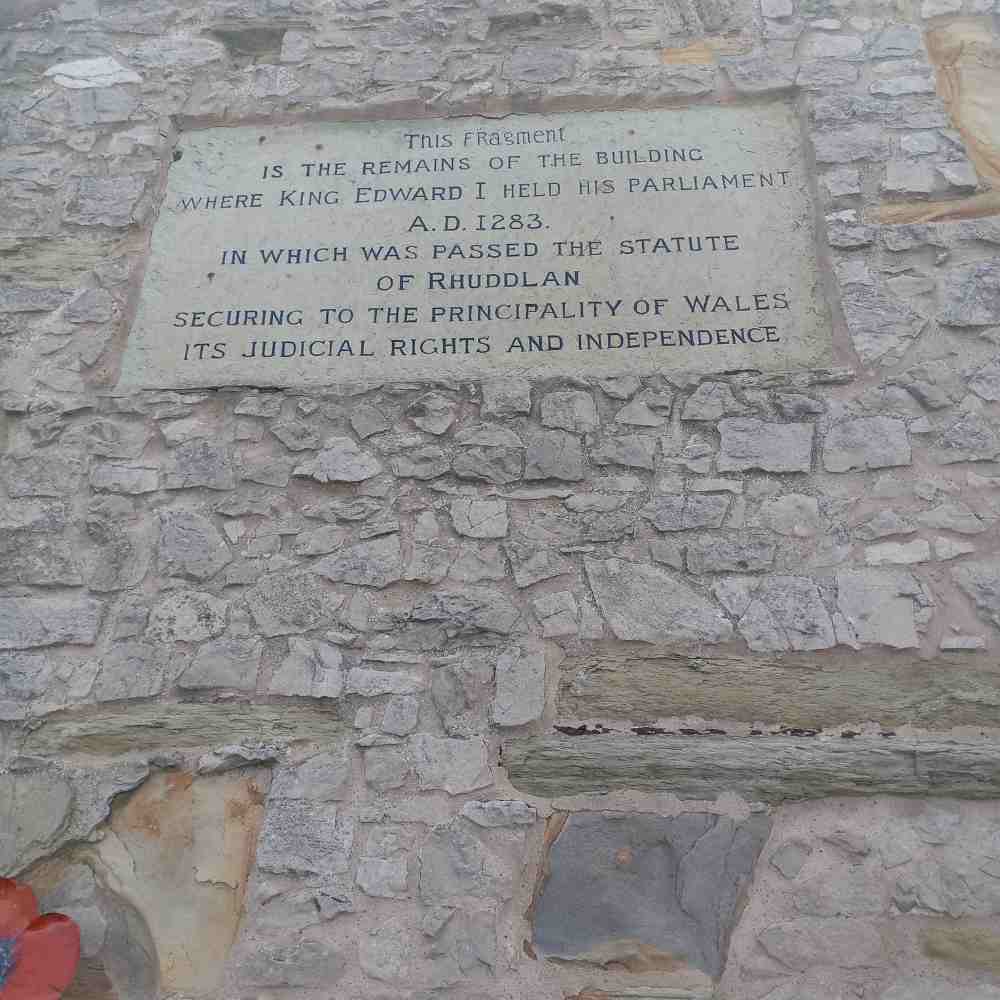
Parliament House on the High Street carries an inscribed stone that reads: "This fragment is the remains of the building where King Edward I held his parliament A.D. 1283, in which was passed the Statute of Rhuddlan, securing to the Principality of Wales its judicial rights and independence." The inscription was commissioned by William Davies Shipley, Dean of St Asaph from 1774 until his death in 1826, and in my view it gets almost everything wrong. The Statute was issued in March 1284, not 1283, and far from securing Welsh rights and independence, it imposed English law and English-style shires on a conquered Wales. Cadw's listing notes that there is no evidence linking a building on this site to Edward's parliament, and the medieval doorway and window in its walls were probably taken from the castle. It is still worth seeing, as a lesson in how history can be rewritten in stone, and it is only a few minutes' walk from the castle.
Edward I began Rhuddlan Castle in 1277, during his first campaign against Llywelyn ap Gruffudd, and it was completed in 1282 at a cost of £9,613. It guarded an ancient ford on the Clwyd and a new English town, chartered in 1278 and settled mainly by English colonists. In March 1284 Edward issued the Statute of Rhuddlan here, which brought English law and English-style shires to the conquered principality. A later tradition, first recorded in the sixteenth century, says it was here that Edward promised the Welsh a prince born in Wales who spoke no English. The castle held out against Owain Glyndŵr in 1400, was taken by Parliament in 1646, and was partly demolished (slighted) in 1648 so it could not be used again. For the full story, including how Edward moved a river, see the castle that moved a river and our guide to the Statute of Rhuddlan explained.
Read the full history of Rhuddlan Castle
Rhuddlan sits in the middle of one of the richest stretches of castle country in Wales. A few miles up the coast are the earthworks of the Norman castle Owain Gwynedd burned in 1167: our guide to visiting Prestatyn Castle covers parking and access, and it makes a quick stop on the same day. Further east, Flint Castle on the Dee estuary was the first castle of Edward's Iron Ring, begun in the same campaign as Rhuddlan. A few miles beyond Flint, Ewloe Castle, built by the Welsh princes, hides in the woods of Wepre Park: our guide to visiting Ewloe Castle covers the roadside lay-by and the steep path in. Inland, Denbigh Castle commands the Vale of Clwyd from its ridge, and our guide to visiting Denbigh Castle covers its free car park, Cadw tickets and the free great gatehouse. The Victorian Bodelwyddan Castle is only a short drive away. If you are wondering why this corner of Wales has so many fortresses, why North Wales has so many castles sets the scene.
Before you set off, download our free Flint Castle illustrated guide or Denbigh Castle illustrated guide, browse all our free illustrated castle guides, or see more castle visitor guides.
Yes. There is a free visitor car park immediately outside the castle, with room for about 25 cars and two electric vehicle charge points. If it is full, the town centre is only a few minutes' walk away.
No. Rhuddlan Castle is run by Cadw and has an admission charge. Entry is free for Cadw members, children under 5, and a disabled person and their companion. Check the Cadw website for current prices before you visit.
Allow at least an hour for the castle itself. Add time for Twthill, a short walk to the south, and for Parliament House on the High Street. In summer the grassy bank by the castle is a lovely spot for a picnic.
Partly. Cadw has made much of the site accessible and rates the terrain as its easiest grade, but the walls and towers cannot be reached by wheelchair. The historic steps into the moat are uneven and have no handrails, and some paths are gravel or cobbles.
Yes. Dogs on short leads are welcome on the ground-level areas of the site. Keep them away from the steep edges of the moat.
Yes. Twthill, the Norman motte raised in 1073, stands a short walk south of the castle and is free to visit. It is easy to reach on foot, but the mound itself is very steep.
Visitor details last checked on 17 October 2026. Opening times, prices and parking can change, so check with Cadw before you travel.
Images may be reused with a credit link to historiesandcastles.com. See our image licence.


Published: 17 October 2026 | Last Updated: 18 October 2026

Regular podcasts by Histories and Castles to help you get a deep dive understanding of histories events and figures.


