Your cart is empty
Tax included and shipping calculated at checkout

Cart Error
Drawer menu
Your cart (0)
Tax included and shipping calculated at checkout

Ewloe Castle is a free, open-access Cadw monument hidden in the woods of Wepre Park in Flintshire. You park in a small roadside lay-by and walk in on a path that is steep and slippery in places, so it is not one for anyone with mobility issues. Allow up to an hour on site. Here is what you need to know before you go, from my own visit in October 2026.
Definitely. Ewloe is off the beaten track, and it is one of the most often overlooked castles in North Wales. That is a large part of its charm. Most Welsh princes built on high, lofty crags, but Ewloe sits in a hollow, hidden among the trees, and you come upon it almost by surprise. It is atmospheric, quiet and quite unlike any other castle on this coast. Entry is free, and you can walk into the D-shaped Welsh Tower and around both wards.
The castle stands in the woods of Wepre Park, between Ewloe and Connah's Quay in Flintshire. Cadw gives the postcode as CH5 3BZ and describes the site as about a mile north-west of Ewloe and two miles north-west of Hawarden, just off the A55. The what3words address for the castle is ///stag.porridge.large. Use the map below for directions, and note that the postcode covers nearby houses, so follow the map pin rather than a house number.
I parked in the roadside lay-by that Cadw recommends. It has room for only about five cars, and it sits on a busy road, so take care getting in and out of the car, especially with children. From the lay-by, a field gate and a small gate lead you onto the path to the castle.


The alternative is Wepre Park's own car park, on the other side of the woods. It is pay and display, and it means a much longer walk to the castle. The park itself is very beautiful, though, so if you would like a longer woodland walk, it is a good choice.
Honestly, I don't think Ewloe Castle can practically be reached by public transport. If you want to try, Traveline Cymru (0800 464 0000) can check the latest bus times to Ewloe or Connah's Quay, but expect a long walk from any stop. Cyclists can use National Cycle Network Route 5 or 568, which Cadw says pass about three miles from the castle.
Ewloe Castle is free to visit and open all year, during reasonable daylight hours. There are no tickets and no staff. Entry is free and open access, so you can go into the Welsh Tower and walk around the grounds. These details were checked on the Cadw Castell Ewloe page on 17 October 2026. Check it again before you set off, in case of closures.
Cadw rates the terrain as Level 3, Moderate, and I would say that is fair. The walk from the lay-by is about 500 metres and takes 10 to 15 minutes. The path crosses farmland, then drops into the woods, and it is slippery and steep in places and boggy after rain. Access is very limited, and I would not recommend Ewloe for anyone with mobility issues, or for pushchairs.

The woods are popular with dog walkers, and Cadw welcomes dogs on short leads on the ground floor levels of the castle. Keep them on the lead near the steps and the wall walk, and away from the plants.
Ewloe is small, but it is one of the clearest examples of a castle built by the Welsh princes rather than the English. On the ground you will find:
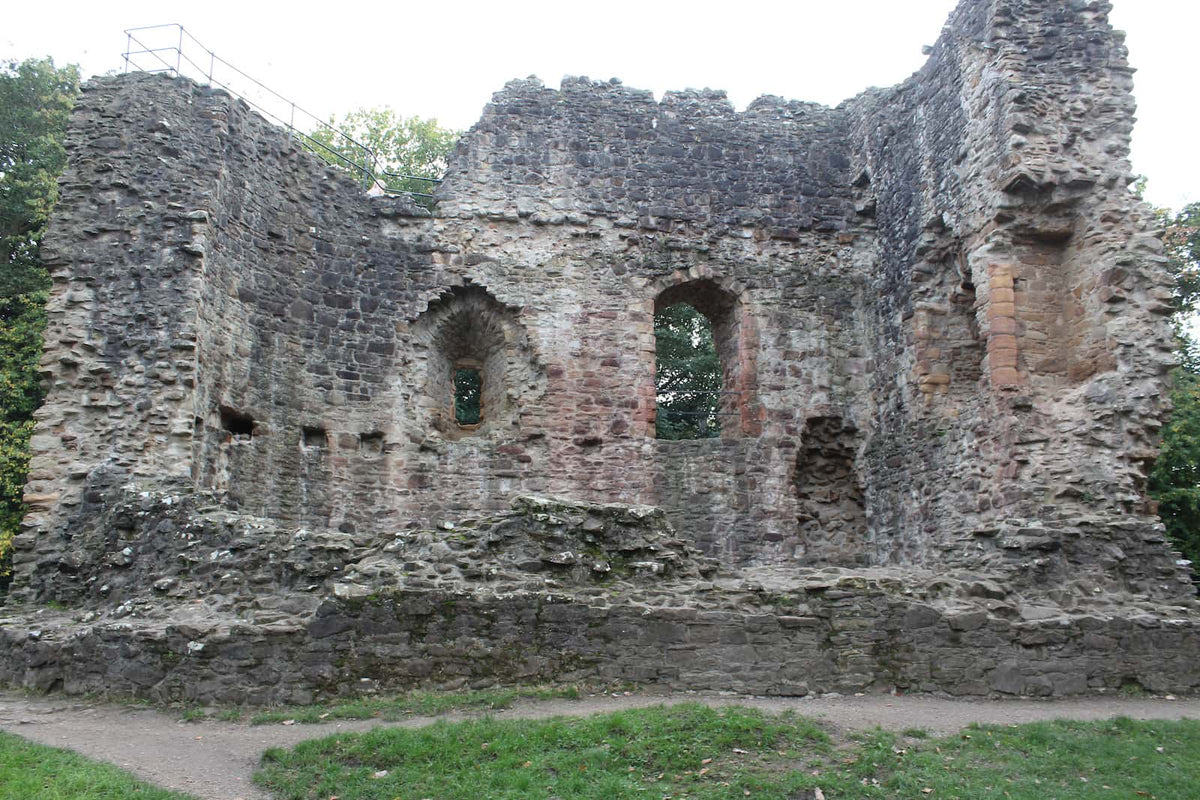

Ewloe is a native Welsh castle. The D-shaped Welsh Tower was probably begun by Llywelyn ab Iorwerth (Llywelyn the Great) some time after 1210. His grandson, Llywelyn ap Gruffudd, won back this part of Flintshire in 1257 and strengthened the castle, adding the lower ward, its curtain walls and the round western tower. The woods were already famous: in 1157 Owain Gwynedd's men ambushed Henry II's army here. Ewloe has no recorded part in the war of 1277. Once Edward I's army overran north-east Wales that summer and began building Flint Castle a few miles away, Ewloe was never used as a stronghold again.
Read the full history of Ewloe Castle
Ewloe pairs perfectly with Flint Castle on the Dee estuary, which Cadw puts about four and a half miles away. It was the first castle of Edward I's Iron Ring, begun in the very campaign that left Ewloe empty, so seeing the two on the same day shows you both sides of the conquest. Further along the coast, our guides to visiting Rhuddlan Castle and visiting Prestatyn Castle cover parking and access for two more stops, and inland, our guide to visiting Denbigh Castle covers the great gatehouse above the Vale of Clwyd. To meet the prince who strengthened Ewloe, read our life of Llywelyn ap Gruffudd, the last native Prince of Wales.
Before you set off, download our free Flint Castle illustrated guide, browse all our free illustrated castle guides, or see more castle visitor guides.
Yes, but only a little. There is a roadside lay-by for about five cars, beside a busy road, and the castle is a 10 to 15 minute walk from it. Wepre Park's pay and display car park is on the other side of the woods, but it means a much longer walk.
Yes. Ewloe Castle is cared for by Cadw and is free to visit. It is open all year during reasonable daylight hours, with free, open access to the Welsh Tower and the grounds.
An hour at most on site is plenty. Add 10 to 15 minutes each way for the walk in from the lay-by, or longer if you park in Wepre Park.
No. The path from the lay-by crosses farmland and woodland and is steep, slippery and boggy in places, and the castle itself has steps and a wall walk. It is not recommended for anyone with mobility issues.
Yes. Dogs on short leads are welcome on the ground floor levels of the castle, and the woods are popular with dog walkers. Don't let dogs eat the wild plants, as some are poisonous.
Not easily. We don't think it can practically be reached by public transport. Traveline Cymru can check the latest bus times to Ewloe or Connah's Quay, but expect a long walk from any stop.
Visitor details last checked on 17 October 2026. Access, parking and paths can change, so check with Cadw before you travel.
Images may be reused with a credit link to historiesandcastles.com. See our image licence.


Published: 17 October 2026 | Last Updated: 18 October 2026

Regular podcasts by Histories and Castles to help you get a deep dive understanding of histories events and figures.


