Your cart is empty
Tax included and shipping calculated at checkout

Cart Error
Drawer menu
Your cart (0)
Tax included and shipping calculated at checkout

Prestatyn Castle was a Norman frontier outpost that lasted barely three years. Founded in about 1164 by Robert de Banastre on an exposed coastal plain, it fell to Owain Gwynedd in 1167. Despite sophisticated concrete foundations, no amount of engineering could overcome the site's strategic vulnerability.
In the low-lying fields to the east of Prestatyn's modern railway station, tucked away near the shadows of Nant Hall, lie the sobering remains of a vanished age. To the modern commuter, these subtle, grass-covered mounds are little more than a topographical curiosity. Yet, they represent one of the most precipitate failures in the history of the Welsh Marches. This was once a high-stakes military investment by the Angevin monarchy, a stone-and-timber assertion of power in the mid-twelfth-century "Middle Country," or Perfeddwlad. Built to anchor a new colony between the River Conwy and the River Dee, the fortress vanished within barely three years. Its story is not one of a long, glorious history, but of a fragile frontier "startup" that collapsed before its mortar was even truly dry.

The castle's life was a mere flicker in the long, dark night of the Welsh borderlands: its defences were raised and razed within three summers. Henry II granted Prestatyn to the Norman lord Robert de Banastre (sources date the grant anywhere from 1157 to 1165), and the castle itself is usually dated to about 1164. The site was intended to be a permanent administrative node. However, the political landscape of the 1160s was treacherous, and the Norman grip was far from immutable. In 1167, a resurgent Welsh coalition led by Owain Gwynedd, his brother Cadwaladr, and Rhys ap Gruffudd swept through the eastern territories. Prestatyn was captured and destroyed, having stood for barely three years, from about 1164 to its destruction in 1167.
Today, the site is an exercise in "Ozymandias-esque" irony. The spot where a timber keep once commanded the coastal plain is now marked by a modern stone rubbing stone, placed atop the motte for the convenience of scratching livestock. This serves as a poignant reminder of how quickly the grand designs of empire can be reclaimed by the earth.
"Three summers, from about 1164 to 1167, were all it took to expose how fragile the Norman grip on the North Welsh coast really was."
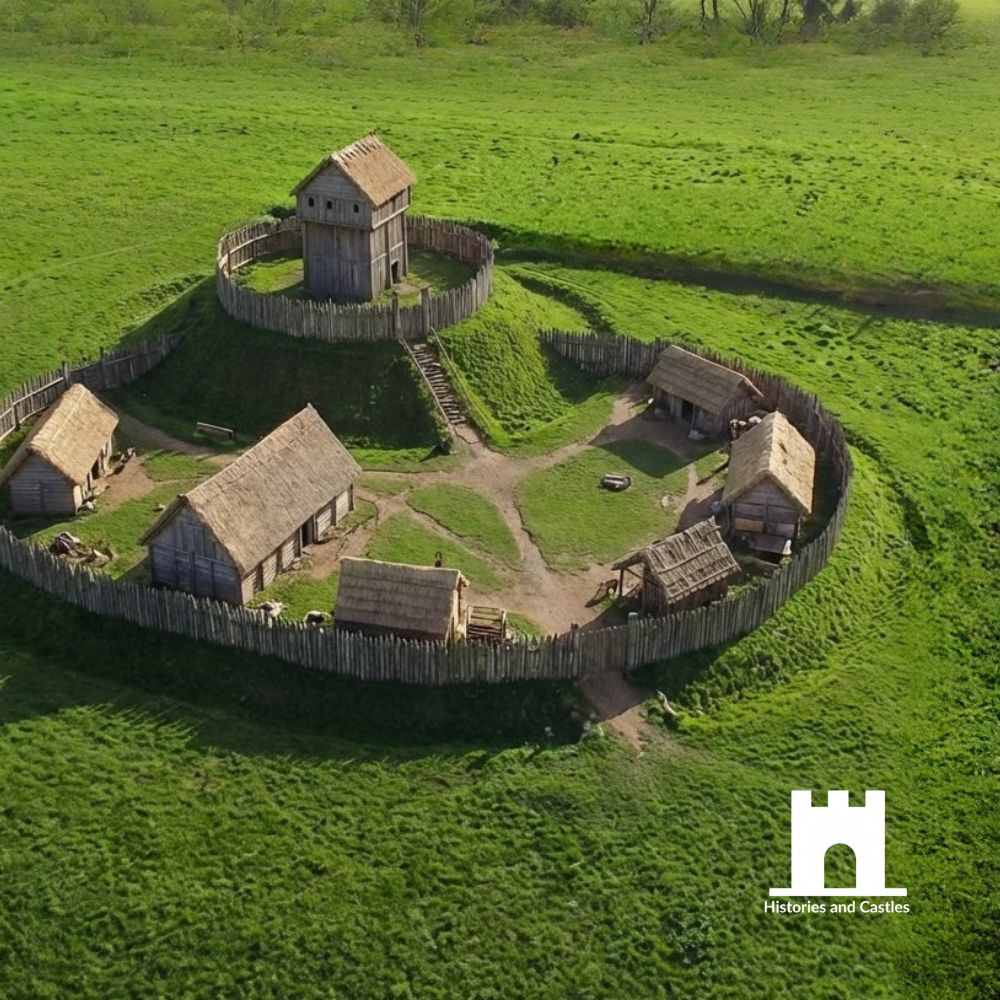
Despite its brief tenure, Prestatyn was no crude outpost. Excavations in 1913 revealed that the Norman builders brought a surprising degree of technical sophistication to this marshy enclave. To stabilise a massive stone curtain wall on the soft, waterlogged ground of the coastal plain, engineers used a sophisticated foundation of concrete made from lime and gravel.
This concrete was laid over a natural bed of calcareous tufa, a porous limestone common to the area, which provided a spread foundation for the 1.2-metre thick stone walls. There is a profound irony in this permanent, "high-tech" engineering; the Normans invested immense resources and skill into a site that would be levelled by Welsh torches only a few years after the foundations were laid. It was a masterpiece of military masonry built upon a strategic foundation of sand.
Historians have long been puzzled by the site's layout, often describing it as "unusual" or "eccentric." While the standard Norman motte-and-bailey typically followed a "figure-of-eight" plan, Prestatyn utilised a concentric arrangement where the bailey appears to have entirely enclosed the motte.
A compelling hypothesis suggests this design was not an innovation, but an attempt to "overwrite" a pre-existing Welsh power centre. The unusual rectangular bailey likely mirrors the footprint of a traditional Welsh llys, an administrative enclosure, within which the Normans simply dropped their motte. By repurposing the existing Welsh site, the Normans sought to co-opt local authority, though this shortcut perhaps contributed to the site's tactical vulnerability on the flat, exposed plain.
"The defining characteristic of Prestatyn Castle is that the bailey appears to have entirely enclosed the motte... a different defensive philosophy than the more common figure-of-eight plan."
The failure of Prestatyn was a total social collapse, not merely a military one. Robert de Banastre did not come alone; he brought "all his people", settlers likely from Cheshire, to establish a self-sustaining hub. This fledgling colony included a market, a mill, a blacksmith, and a granary, with cottages lining the way to Nant Hall.
When the Welsh coalition sacked the castle in 1167, the destruction was so absolute that it necessitated a total evacuation of the English population. This diaspora served as a catalyst for a new family history; the Banastres fled to Lancashire to land granted by Henry de Lacy. There, the family transitioned from the unstable timber mottes of the frontier to the life of landed English gentry, eventually constructing the grand Jacobean mansion of Bank Hall. The fall of Prestatyn was the end of their Welsh dream, but the beginning of their English legacy.
A century after the torches had gone out, the Banastre family attempted to reclaim their lost heritage. In 1279, following the Edwardian conquest, a second Robert Banastre petitioned the Crown for the return of his ancestral lands. An Inquisition held on 13 December 1279 confirmed the family's historical trauma: their forefather had indeed been violently ejected by Owain Gwynedd.
However, the cold hand of Edwardian pragmatism intervened. The Crown denied the petition, ruling that because the King had "recovered" the lands through his own wars, he held "absolute discretion" over their redistribution. At the time, the site was held by Robert Crevequer, a noble in the King's favour. The strategic value of the original site had expired, and the legal system effectively erased the Banastre claim to make way for a new administrative order.
The modern landscape of Prestatyn is a palimpsest of historical ambition. The castle ruins sit at the northern terminus of the Offa's Dyke Path, a trail commemorating an eighth-century boundary, while the horizon is dominated by the 21st-century North Hoyle Wind Farm, the UK's first major offshore energy project.
The "failure" of Prestatyn invites us to reflect on the nature of frontiers. Was the castle's collapse merely a tactical error of building on a vulnerable plain, or was it the inevitable result of a "negotiated" frontier that the Normans could not yet hope to control? Perhaps the site's true failure was the belief that stone and concrete could ever truly silence the sovereignty of the landscape.
Coflein: Aerial photographs showing the shape of the original castle earthworks at Prestatyn.
Cadw Scheduled Monuments Full Report: Official heritage record for Prestatyn Castle, including architectural and archaeological data.
Planning a visit? The castle survives only as earthworks in a field beside the A548, with no car park. Our guide to visiting Prestatyn Castle: parking, access and what to see covers where to park, how to reach the field safely and what you can see on the ground today.
This article is part of the medieval castles in Wales series and our wider guide to the castles of England and Wales.
Prestatyn Castle: The Full Story: The complete history of the castle from founding to destruction.
Prestatyn vs Flint Castle: The Evolution of Welsh Frontier Defence: How the lessons of Prestatyn's failure shaped Edward I's far more successful Flint Castle.
Rhuddlan Castle: Edward I's Fortress of Conquest: The castle Owain Gwynedd besieged for three months before turning on Prestatyn in 1167.
The Welsh Frontier Castles and Their Role in Medieval Times: The wider strategic context of Norman castle-building along the Welsh border.
Why Are There So Many Castles in North Wales?: The density of Norman and Edwardian fortifications along this frontier, explained.
Prestatyn Castle was caught in the violent political reversals of the 1160s. Although its Norman builders used genuinely advanced engineering, including lime-and-gravel concrete foundations to stabilise walls on marshy ground, the site itself was strategically exposed. It sat on a flat coastal plain with no natural elevation to protect it, and it lay deep in territory that Owain Gwynedd and the princes of Gwynedd had every motive to reclaim. When a united Welsh coalition under Owain Gwynedd, Cadwaladr, and Rhys ap Gruffudd swept north in 1167, the castle had no defensible depth to fall back on. Good masonry is no substitute for a good position.
The destruction was total enough to force a complete evacuation. Robert de Banastre had brought settlers with him from Cheshire, including a blacksmith, a miller, and a granary keeper, all the trades needed to sustain an English colonial enclave. When the Welsh burned the castle in 1167, those people had to leave. The Banastre family itself fled south and east to Lancashire, where land was granted to them by Henry de Lacy. There they rebuilt: the family went on to become established landed gentry and eventually built the Jacobean mansion of Bank Hall. Prestatyn ended their Welsh ambitions but gave them an English future.
No. A century after the destruction, a descendant named Robert Banastre petitioned King Edward I to restore the family's ancestral lands following the Edwardian conquest of 1277. An inquisition held in December 1279 confirmed that the family had indeed been violently ejected by Owain Gwynedd. Despite this, Edward I refused the petition. By then the site at Prestatyn had lost whatever strategic significance it once had, Edward's new ring of coastal fortresses at Flint, Rhuddlan, and Caernarfon made it redundant, and the Crown preferred to redistribute the land to Robert Crevequer, a noble already in royal favour.
A standard Norman motte-and-bailey followed a figure-of-eight layout, with the raised motte sitting outside but adjacent to the bailey enclosure. Prestatyn reversed this: the rectangular bailey appears to have entirely surrounded the motte, creating a concentric arrangement that archaeologists have found puzzling. The leading explanation is that the Normans were not designing from scratch but overwriting an existing Welsh administrative site, a llys. The rectangular bailey likely preserves the footprint of that earlier Welsh enclosure, with the Norman motte dropped inside it. If correct, it means Prestatyn was an attempt to co-opt Welsh authority rather than replace it outright, and probably a weaker position as a result.
Prestatyn Castle was built by Robert de Banastre, a Norman lord who received a grant of land in North Wales from King Henry II (sources date the grant anywhere from 1157 to 1165). The castle itself is usually dated to about 1164. The grant was part of a broader Angevin effort to extend English authority into the Perfeddwlad, the contested Middle Country between the River Conwy and the River Dee. Robert did not come alone: he brought settlers from Cheshire to populate a planned colonial borough around the castle. The castle was designed by unknown Norman military engineers who demonstrated an unusual degree of sophistication for the period, using concrete foundations to stabilise stone walls on ground that would have challenged simpler construction methods.
The remains of Prestatyn Castle survive as low earthworks near Nant Hall, on the eastern edge of Prestatyn in Denbighshire, North Wales (postcode LL19 7HT). There is no standing masonry: the castle was destroyed in 1167 and never rebuilt, and the site is now a scheduled monument at the northern end of the Offa's Dyke Path. For parking, access and what you can see on the ground, read our guide to visiting Prestatyn Castle.
This article supports UK GCSE and A-Level History modules covering Norman consolidation, frontier control, and Anglo-Welsh medieval conflicts:
Paper 2: Shaping the Nation – Section B: Norman England, c1066–c1100 / Medieval England
Module Focus: Explores Norman military architecture, motte-and-bailey construction techniques, and methods used by Norman lords to establish control and territorial authority along volatile borderlands.
Paper 2: Period Study – Option 11: Kingdoms in Medieval Britain, c.1066–1286
Module Focus: Examines Henry II's border policies, the expansion of Norman Marcher influence in North Wales, and native Welsh resistance led by leaders such as Owain Gwynedd.
Unit Y103: England 1035–1107 & Unit Y104: England 1199–1272
Module Focus: Provides insight into Anglo-Norman frontier strategy, the co-opting of local Welsh power bases (llys sites), and the long-term legal and land dispute consequences under Edwardian crown pragmatism.
Component 1: British Study in Depth – Medieval Wales and the Conquest, c.1063–1283
Module Focus: Crucial case study detailing the conflict between Anglo-Norman colonisation and native Welsh princes, highlighting the destruction of Prestatyn Castle by Owain Gwynedd in 1167.
Licence: Images may be reused with a credit link to historiesandcastles.com. See our image licence.


Published: 14 April 2026 | Last Updated: 17 October 2026
Regular podcasts by Histories and Castles to help you get a deep dive understanding of histories events and figures.
