Your cart is empty
Tax included and shipping calculated at checkout

Cart Error
Drawer menu
Your cart (0)
Tax included and shipping calculated at checkout

Statute of Rhuddlan (1284) transformed military conquest into constitutional governance. After destroying Welsh princely resistance in 1282, Edward I imposed English law, replaced traditional cantrefs with English-style counties and installed Crown-appointed sheriffs. Wales shifted from a patchwork of principalities into territory governed directly by the English Crown.
The Statute of Rhuddlan (1284) was Edward I of England's legal response to the conquest of Wales. After decades of military campaigns, the death of Llywelyn ap Gruffudd in 1282, and the capture and execution of his brother Dafydd in 1283, Edward had accomplished a total military conquest. The Statute of Rhuddlan formalised this conquest as a constitutional act.
Understanding the Statute of Rhuddlan requires looking beyond the battlefield to the courts, the counties, and the communities it reshaped. This is the story of how Edward I tried to make conquest permanent, and what happened next.
For centuries before 1284, the relationship between England and Wales was complex. The Welsh principalities, particularly Gwynedd in the north, had maintained a degree of independence that alternated between cooperation with and resistance against the English crown. When Edward came to power in 1272, he was determined to change this.
In 1277, Edward's first military campaign resulted in the Treaty of Aberconwy, which stripped the Welsh prince Llywelyn ap Gruffudd of much of his land. However, the peace was short-lived. In 1282, a new conflict arose, and Llywelyn ap Gruffudd was killed, his brother Dafydd captured and executed.
Edward now faced the task of governing a newly conquered territory with minimal organised opposition, and he was going to do so through one of the most significant pieces of legislation the medieval world had yet seen.
The Statute was issued in March 1284 and contained three main measures that were to shape the future of Wales:
For centuries, the Welsh had followed their own set of laws and customs, collectively known as the Law of Hywel Dda. The Statute of Rhuddlan replaced much of this with English common law, which had significant implications for the Welsh. The change was more than a change in law; it was a change in culture.
Under the new law, courts were held in English, English procedures were followed, and English standards of proof and penalty were applied. The Welsh were expected to adapt to this entirely new system.
The Statute also reorganised the political geography of Wales. The old Welsh divisions of cantrefs and commotes were replaced with English-style counties. This reorganisation mirrored the English administrative structure, creating a more centralised and hierarchical form of governance.
These new counties, including Anglesey, Caernarfon, Merioneth, Flint, Carmarthen, and Cardigan, were each governed by a sheriff appointed by the king. The sheriff was responsible for implementing the king's justice and maintaining order, in much the same way as sheriffs in England.
The Statute also had significant implications for the ownership and use of land in Wales. English lords were granted vast tracts of land previously held by the Welsh. The Welsh were reduced to tenant farmers, and their rights to own land were severely restricted.
The economic implications were profound. The Welsh were effectively excluded from owning or controlling the most important economic resource of the time: land. This was a deliberate strategy to create a dependent Welsh population that would be reliant on the English for their livelihood.
The response to the Statute was mixed. Some Welsh, particularly the nobility, sought to work within the new system and maintain their social status. Others resisted, leading to sporadic rebellions that challenged English control.
The most significant of these rebellions was led by Madog ap Llywelyn in 1294 to 1295. Despite initial successes, the rebellion was eventually crushed by Edward's overwhelming military force. The failure of these rebellions further reinforced English control over Wales.
In the centuries that followed, the Welsh continued to resist English control in various ways, but the Statute of Rhuddlan had fundamentally changed the political landscape. The Welsh language and culture survived, but Welsh political independence was effectively extinguished.
Go deeper into the evidence
Medieval law was not a neutral system. It protected the powerful, punished the poor, and drew sharp lines between those who could claim its shelter and those who could not.
 Digital Download
Medieval Law and Jewish History Study Guide
From legal protection to persecution and expulsion.
Download now Digital Download
The King's Deer
The forest law was among the most brutal in the medieval statute book.
Download nowThe Statute of Rhuddlan set the stage for the eventual full integration of Wales into England. It was a crucial step in the process of anglicisation that was completed with the Laws in Wales Acts of 1535 and 1542, which formally incorporated Wales into the English legal and parliamentary systems.
The impact of the Statute of Rhuddlan is still felt today. The legacy of English legal and administrative systems, the loss of much of the Welsh land to English lords, and the impact on the Welsh language and culture can all be traced back to the Statute of Rhuddlan. Yet Wales has maintained its cultural identity, language, and a sense of distinct nationhood in the face of these historical forces.
In Rhuddlan itself, a building on the High Street known as Parliament House carries an inscribed stone that reads: "This fragment is the remains of the building where King Edward I held his parliament A.D. 1283, in which was passed the Statute of Rhuddlan, securing to the Principality of Wales its judicial rights and independence." The inscription was commissioned by William Davies Shipley, Dean of St Asaph from 1774 until his death in 1826.

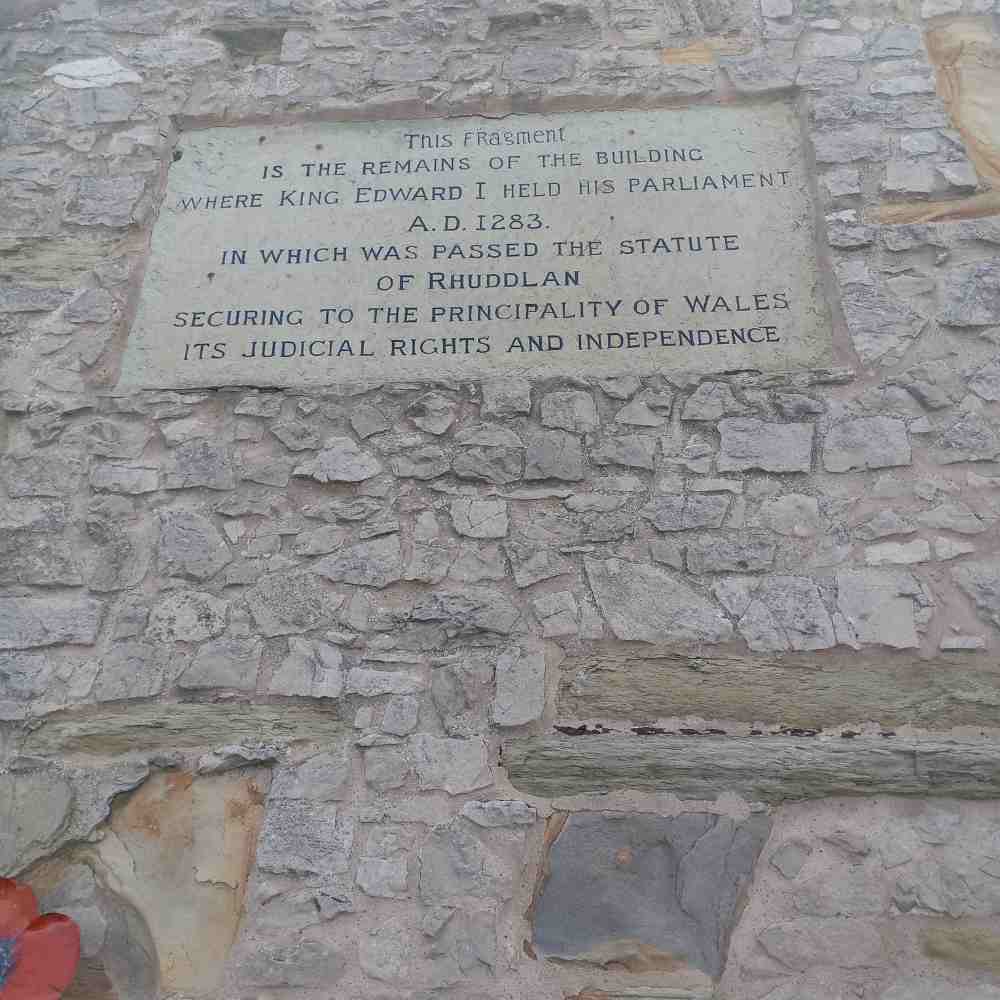
In my view the plaque gets almost everything wrong. The Statute was issued in March 1284, not 1283. Far from securing Welsh judicial rights and independence, it did the opposite: as this article shows, it replaced Welsh law with English common law in criminal matters and divided the conquered principality into English-style counties under royal sheriffs. Even the building's claim is doubtful. Cadw's listing notes that there is no evidence linking a building on this site to Edward's parliament, and the medieval doorway and window in its walls were probably taken from the castle.
The plaque is best read as a product of its own time, a Georgian churchman's flattering retelling of a conquest, rather than as evidence about 1284. It is still worth seeing if you are in Rhuddlan, and our guide to visiting Rhuddlan Castle shows where to find it.
The Statute of Rhuddlan was a pivotal moment in the history of Wales and England. It transformed the relationship between the two countries, setting the stage for the eventual full integration of Wales into England. Yet the Welsh spirit of independence and cultural identity have endured. Understanding the Statute of Rhuddlan is key to understanding Wales today.
Military conquest creates control through force. Constitutional governance creates control through law. The Statute of Rhuddlan achieved the second by embedding English legal and administrative structures into Welsh life. It extended English common law, created county governance under royal sheriffs, established royal courts and restricted Welsh magnate authority. These measures transferred power from native tradition to Crown administration in ways that would outlast any military garrison. Future rebellions, including those of Madog ap Llywelyn in 1295 and Owain Glyndwr in 1400, could disrupt but not dismantle this framework. Constitutional change proved more durable than military occupation alone.
The statute operated through three decisive measures. First, it extended English common law into Wales, displacing the legal tradition of Hywel Dda in criminal justice and major civil matters. Royal courts replaced native legal authority. Second, it restructured Welsh territory into counties modelled on England, each governed by a Crown-appointed sheriff. The traditional Welsh divisions of cantref and commote gave way to shires and circuits, with governance radiating from Westminster. Third, it reshaped land: English settlers received privileged access in new boroughs, while Welsh magnates found traditional dominance eroded. Law, administration and land combined to institutionalise English authority.
Earlier Anglo-Welsh relations had been characterised by negotiated arrangements acknowledging Welsh autonomy. The Treaty of Montgomery of 1267 recognised Llywelyn ap Gruffudd as Prince of Wales with authority over other Welsh lords. Welsh princes acknowledged English overlordship in theory but governed independently in practice. The Treaty of Aberconwy of 1277 reduced Llywelyn's territory but preserved his title and nominal authority. The Statute of Rhuddlan broke with this tradition entirely. There was no negotiation and no preserved Welsh autonomy. It was a unilateral imposition of English governance on a conquered people, not a settlement between two political parties.
After 1284, Wales occupied a curious constitutional position. It was neither a separate kingdom, as Scotland remained, nor was it simply an extension of the English shires. It was conquered territory governed directly by the English Crown under a distinctive administrative arrangement created by the statute. Welsh subjects were subject to English law but Wales was not represented in the English Parliament. This ambiguous status persisted until the Laws in Wales Acts of 1535 and 1542 under Henry VIII, which incorporated Wales fully into the English legal and parliamentary system. The debates over devolution in the twentieth and twenty-first centuries echo questions first raised in the 1280s.
Subsequent rebellions, most notably Madog ap Llywelyn's revolt of 1294 to 1295 and Owain Glyndwr's campaign from 1400 to 1415, could not reverse the statute because it had created self-reinforcing administrative structures. English counties, sheriffs, courts and borough towns were all embedded in Welsh life. Crown-loyal gentry had taken root across the territory. Even when rebellions temporarily disrupted English control, the institutional framework remained intact. Owain Glyndwr achieved remarkable success for over a decade but ultimately could not dismantle the legal and administrative order established in 1284. The statute had made conquest structural, not merely military.
The Statute of Rhuddlan paradoxically strengthened Welsh cultural identity even as it extinguished Welsh political independence. By imposing English law and administration, it created a sharp boundary between official life and cultural life. Welsh people retained their language, poetry and oral traditions precisely because these things lay outside what the statute could easily reach. Bardic culture flourished as a vehicle for preserving collective memory and resistance. When Owain Glyndwr raised his revolt in 1400, he could draw on over a century of cultural memory shaped partly by resentment of the 1284 settlement. The conquest created both subjugation and the conditions for enduring national feeling.
The Statute of Rhuddlan brought uneven economic change to Wales. Edward I's extensive castle-building programme created new borough towns at Caernarfon, Conwy, Harlech, Flint and elsewhere. These boroughs encouraged trade and commerce but often privileged English settlers, who held market rights and civic privileges that Welsh inhabitants were denied in many towns. The influx of English officials, merchants and soldiers created new economic activity around these centres of power. Over time, participation in these markets drew Welsh communities into the wider English economic network, though the initial terms of that participation were deliberately unequal.
The Statute of Rhuddlan remained the constitutional basis of Welsh governance for over 250 years. It set the precedent that Wales was not a foreign kingdom subject to negotiated relations with England, but territory governed directly by the English Crown. This framework paved the way for the Laws in Wales Acts of 1535 and 1542 under Henry VIII, which formally incorporated Wales into the English legal and parliamentary system. The sixteenth-century legislation completed what the 1284 statute began. Today, the Statute of Rhuddlan is central to understanding medieval Wales and the long history of Welsh-English constitutional relations.
This article is part of the Medieval Laws series. Explore all articles at Medieval Laws.
This article supports UK GCSE and A-Level History modules covering the Edwardian conquest of Wales, legal reorganisation, and medieval administrative control:
Paper 2: Section A – Britain: Power and the People: c1170 to the Present Day
Module Focus: Examines the expansion of English royal authority into Wales, analyzing how Edward I integrated newly conquered Welsh territories under English common law and royal administration following the defeat of Llywelyn ap Gruffudd.
Paper 2: Option 11 – Medieval Depth Study: Crown and Authority in Late Medieval England
Module Focus: Details the aftermath of the 1282–1283 war, the abolition of native Welsh law (Cyfraith Hywel), the creation of new English shires (such as Anglesey, Caernarfon, and Merioneth), and the consolidation of royal power.
Unit Y108: The Early Plantagenets 1154–1377 / Late Medieval British Depth Studies
Module Focus: Provides critical analysis of Edwardian legal administration, the restructuring of Welsh governance, and the integration of the Principality of North Wales into the English crown's administrative sphere.
Component 1: Depth Study – Government, Rebellion and Society in Wales and England c.1215–1307
Module Focus: Focuses specifically on the enactment of the Statute of Rhuddlan in 1284, the dismantling of native legal traditions, the establishment of royal officials like sheriffs and coroners, and the profound constitutional impact on medieval Wales.
Images may be reused with a credit link to historiesandcastles.com. See our image licence.


Published: 24 September 2026 | Last Updated: 17 October 2026
Regular podcasts by Histories and Castles to help you get a deep dive understanding of histories events and figures.


