Your cart is empty
Tax included and shipping calculated at checkout

Cart Error
Drawer menu
Your cart (0)
Tax included and shipping calculated at checkout

Flint Castle stands on the shore of the Dee Estuary, right beside the town of Flint in Flintshire. It is free to enter, there is a car park close by, and the railway station is only a short walk away. There are no staff or facilities on site, so come prepared, and allow a good hour. Here is what you need to know before you go, from my own visit in October 2026.
Yes. Flint was the first castle Edward I began in his 1277 campaign in north Wales, and it is unlike any other castle he built: three of its corners carry round towers, but the fourth holds a separate great tower, or donjon, standing in its own moat. It is free, open all year and easy to reach by car or train. The real reward is the climb up the north-east tower, where a modern spiral staircase takes you up to a viewing platform over the salt marsh and the wide Dee Estuary. I spent a good hour there and thought the tower alone was well worth the trip.

The castle sits on the edge of the estuary, just east of Flint town centre, between the town and the shore. Cadw gives the postcode as CH6 5PH, and the what3words address for the castle is ///credit.whizzing.grumbles. By road, Cadw recommends the A548 coast road, which runs through Flint between Queensferry and Holywell. Once you are in the town, follow the brown signs for the castle rather than relying on the postcode alone. Use the map below for directions.
I parked in the car park by the castle, and parking was free on the day of my visit. Cadw says that public car parks are signposted around the town with good access to the castle, and gives ///trade.fear.unloads as the what3words address of the nearest one. That car park is not run by Cadw, so charges and rules are set locally and could change. Cadw also lists one dedicated disabled parking space, about 100 metres from the castle.
Flint is one of the easiest castles in Wales to reach by train. Flint railway station is on the North Wales Coast line between Chester and Holyhead, and Cadw puts it about 270 metres from the castle. It took me about 20 minutes to walk from the station, but that was at an easy pace through the town, and a direct walk will be quicker. National Cycle Network Route 5 passes the castle, and so does the Wales Coast Path. Traveline Cymru (0800 464 0000) and National Rail Enquiries (03457 48 49 50) can check the latest times.
These details were checked on the Cadw Flint Castle page on 20 October 2026.
I visit Cadw sites with a Cadw membership, but you won't need one at Flint, because entry is free for everyone.

You reach the castle along a walkway and through a gate, with the inner ward and its towers beyond. Cadw rates the terrain as Level 2, Easy. Inside the castle, though, the ground is mostly grass, with few hard surfaces. It had rained on the day of my visit, and the path was a bit muddy, so wear sensible shoes.


Dogs are allowed. Cadw welcomes dogs on short leads on the ground floor levels, so leave them below when you climb the tower. Flint is also a good place for a dog walk: from the castle you can follow the coast along the estuary and on through the nearby woods, which makes a pleasant walk before or after your visit.
Flint is compact, but there is more to it than first appears. On the ground you will find:
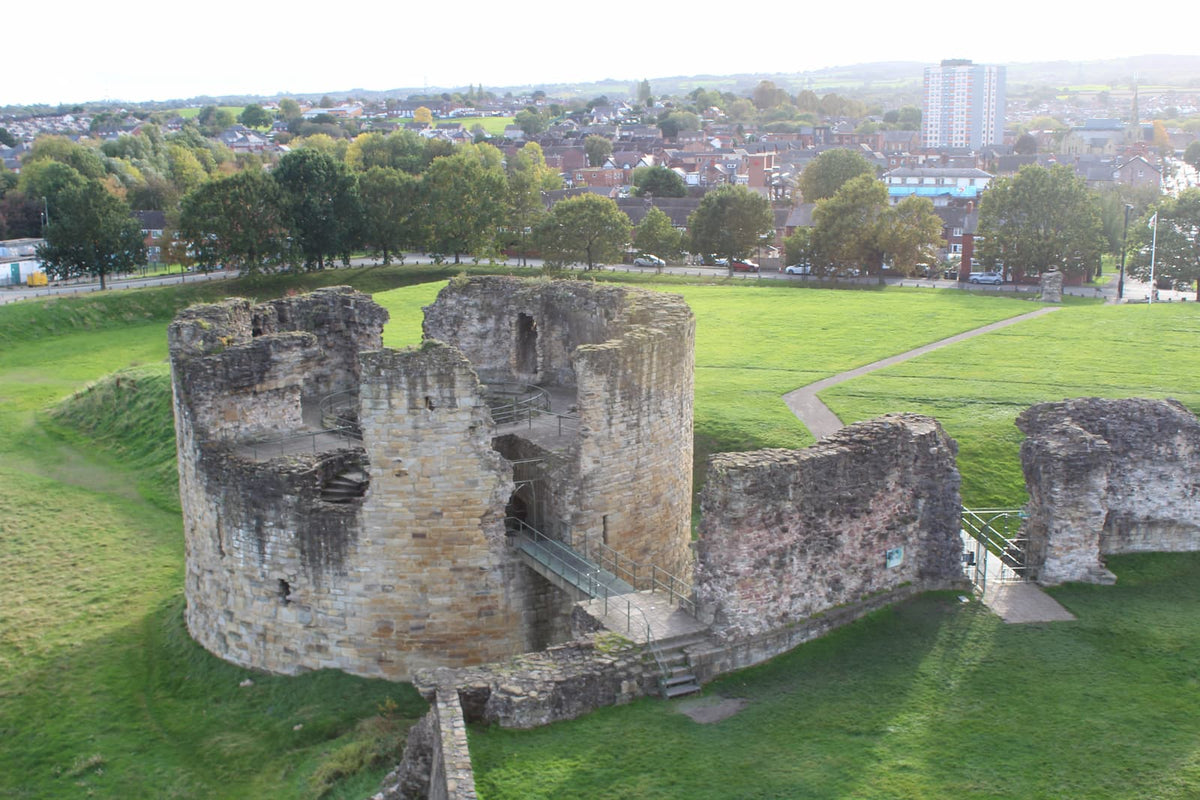


There are no facilities at Flint Castle: no toilets, no shop, no café and no Cadw staff. Bring a drink with you, and plan to use the shops and cafés in Flint town centre, which is only a few minutes' walk away.
Pick a clear day if you can. The view from the top of the north-east tower, out over the salt marsh and the Dee Estuary, is the best thing about Flint, and it is at its finest when the weather is bright. Even on an overcast day the castle is still well worth a visit, and because it is free and open all year, it makes an easy stop whenever you are passing along the coast.


Flint was the first castle Edward I began in his war against Llywelyn ap Gruffudd, with work starting in the summer of 1277. It was largely finished by 1284, and its separate great tower was modelled on castles in Savoy, the homeland of the king's master mason, James of St George. In August 1399 Richard II surrendered to his cousin Henry Bolingbroke here, a few weeks before he lost his crown. Held for the king in the Civil War, Flint surrendered to Parliament in 1646 and was slighted in 1647.
Read the full history of Flint Castle

If you have a dog, or simply want to stretch your legs, the walk from the castle along the coast and through the nearby woods is a pleasant way to round off a visit.
Flint also sits at the heart of a cluster of castles. About four and a half miles away, our guide to visiting Ewloe Castle covers the hidden Welsh castle in the woods of Wepre Park. Further west along the coast, our guides to visiting Rhuddlan Castle, Flint's sister castle from the same 1277 campaign, and visiting Prestatyn Castle make good next stops, and our guide to visiting Denbigh Castle covers the great baronial castle in the Vale of Clwyd.
Before you set off, download our free Flint Castle illustrated guide, browse all our free illustrated castle guides, or see more castle visitor guides.
Yes. There is a car park close to the castle, and parking was free when we visited in October 2026. Cadw says public car parks are signposted around Flint, and there is one dedicated disabled space about 100 metres from the castle.
Yes. Entry to Flint Castle is free for everyone. There is no ticket office and there are no Cadw staff on site, so you can simply walk in during opening hours.
Allow a good hour at least. That gives you time to walk round the inner ward, cross to the great tower and climb the north-east tower for the view over the Dee Estuary.
Partly. Cadw rates the terrain as easy, but the ground inside the castle is mostly grass and can be muddy after rain, and the climb up the north-east tower is a spiral staircase with many steps.
Yes. Cadw welcomes dogs on short leads on the ground floor levels, and there is a pleasant dog walk from the castle along the coast and through the nearby woods.
Yes. Flint railway station is on the North Wales Coast line, and Cadw puts it about 270 metres from the castle. It took us about 20 minutes at an easy pace through the town.
Visitor details last checked on 20 October 2026. Opening times, parking and access can change, so check with Cadw before you travel.
Images may be reused with a credit link to historiesandcastles.com. See our image licence.


Published: 20 October 2026 | Last Updated: 20 October 2026

Regular podcasts by Histories and Castles to help you get a deep dive understanding of histories events and figures.


