Your cart is empty
Tax included and shipping calculated at checkout

Cart Error
Drawer menu
Your cart (0)
Tax included and shipping calculated at checkout
Inspired by the events behind the upcoming film The Uprising, releasing on 11 September? Go beyond the big screen and uncover the extraordinary true story that changed medieval England forever.
Sign up today and instantly receive our beautifully illustrated Peasants' Revolt (1381) Infographic packed with fascinating facts, key figures, major battles, and the lasting legacy of one of history's most dramatic rebellions.
Enter your email below to get your FREE infographic instantly.



Ensure the paper is snug but comfortable, and passes over your knuckle.
Use the size guide below to find your perfect fit:
|
Circumference (mm) |
Size |
|
44 |
3 |
|
46 |
3.75 |
|
48 |
4.5 |
|
50 |
5 |
|
51 |
5.5 |
|
52 |
6 |
|
53 |
6.5 |
|
54 |
7 |
|
55 |
7.25 |
|
56 |
7.5 |
|
57 |
8 |
|
58 |
8.5 |
|
59 |
8.75 |
|
60 |
9 |
|
62 |
10 |
Norse people did not wear Thor's Hammer for fashion. Mjolnir pendants were protective amulets: physical appeals to the god's power, worn during storms, at weddings, at the birth of a child, and in the face of enemies. The word "mjolnir" is linked by scholars to Old Norse and Slavic roots meaning lightning, and the hammer was the instrument of that power.
The Valknut on the face of this pendant adds a second layer of meaning. Three interlocked triangles, associated with Odin and the warrior dead, the symbol appears in Viking Age burial contexts across Scandinavia: carved into runestones, scratched into sword pommels, marked on the prows of burial ships. Its precise meaning is still debated by scholars, but its context is not. The Valknut marks a presence Odin had claimed.
Placing the Valknut at the centre of Mjolnir on a single piece is a compositional choice that collapses two of the most significant symbols in Norse religion into one object. For the buyer who knows what they are looking at, this reads as intentional.
What You Are Getting
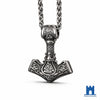
The hammer face is engraved with the raised Valknut at the centre, surrounded by Norse knotwork in a tight border with scroll and beast-curl detail at the corners. The handle runs diamond-pattern knotwork from the collar to the base. The bail is not a plain loop: it is a sculpted form with spiral scrollwork across its top face and twin skulls flanking the chain opening, all darkened in their recesses to match the pendant's overall finish.
The oxidised treatment gives the steel a depth that polished metal does not have. Raised detail reads bright against dark recesses, producing an effect close to how Viking Age silverwork looks in museum collections: worn in, serious, intended.
Material: 316L surgical-grade stainless steel throughout
Finish: Oxidised antique silver or gold-tone
Detail: Raised Valknut, Norse knotwork border, diamond-pattern handle, sculpted skull bail
Chain: Wheat link stainless steel, included
Tarnish resistant. No maintenance required.
Fewer than 100 Mjolnir pendants have been confirmed by archaeology, yet finds reach from Iceland to the Volga. Crucially, they appear more often in women's graves than men's, complicating the modern framing of Mjolnir as a masculine warrior symbol. Mjolnir was used in the heathen blessing rite at marriages, as a counter-symbol to the Christian cross during the conversion period, and as a general protective device. The warrior connotation is real but partial. The protection it offered was for everyone.
Who This Is For
For anyone with a serious interest in Norse religion, Viking Age symbolism, or pre-Christian Scandinavian culture, this pendant carries enough historical layering to reward that knowledge. It also works as a gift: the piece is visually distinctive, the symbolism is genuinely interesting, and the materials are built to last.
Delivery
This piece is sourced to order and typically arrives within 10 days. If you are purchasing as a gift, that window gives you time to plan the presentation. Every order ships tracked and free to UK addresses.
The Valknut, three interlocked triangles, is one of the most recognisable symbols in Norse iconography and one of the least understood. It appears consistently in Viking Age burial contexts: on the Tängelgårda runestone in Gotland, on the Oseberg ship burial, and on carved grave goods from across Scandinavia. Scholars associate it with Odin and with the dead he claimed for Valhalla, but its precise ritual function is still debated. The name itself, "knot of the slain," comes from later Norse scholarship rather than original Viking Age sources. What is clear is that this was not a casual decorative motif. It marked something serious.
316L is a surgical-grade stainless steel alloy used in medical implants and high-quality jewellery because of its exceptional resistance to corrosion and skin reaction. It will not tarnish, rust, or discolour under normal wear conditions. The oxidised finish applied to this pendant is treated into the steel itself and is not a surface coating that wears away. This is a piece you can wear daily without maintenance.
Approximately 10 days to UK addresses. Every order ships tracked and free. If you need the piece by a specific date, contact us before ordering and we will confirm whether timing is achievable.
Yes. The historical weight behind both the Mjolnir and the Valknut gives this piece a level of meaning that most jewellery cannot match. For someone interested in Norse history, Viking mythology, or Scandinavian heritage, the symbolism is immediately recognisable and will be appreciated.
Order the piece that carries the full weight of what Mjolnir was.
Care and Materials
Materials: 316L surgical-grade stainless steel throughout. Oxidised antique silver or gold-tone finish. Raised Valknut and Norse knotwork engraving on hammer face. Sculpted bail with skull detail. Wheat link chain included.
Care instructions: