Your cart is empty
Tax included and shipping calculated at checkout

Cart Error
Drawer menu
Your cart (0)
Tax included and shipping calculated at checkout
Inspired by the events behind the upcoming film The Uprising, releasing in October? Go beyond the big screen and uncover the extraordinary true story that changed medieval England forever.
Sign up today and instantly receive our beautifully illustrated Peasants' Revolt (1381) Infographic packed with fascinating facts, key figures, major battles, and the lasting legacy of one of history's most dramatic rebellions.
Enter your email below to get your FREE infographic instantly.



Ensure the paper is snug but comfortable, and passes over your knuckle.
Use the size guide below to find your perfect fit:
|
Circumference (mm) |
Size |
|
44 |
3 |
|
46 |
3.75 |
|
48 |
4.5 |
|
50 |
5 |
|
51 |
5.5 |
|
52 |
6 |
|
53 |
6.5 |
|
54 |
7 |
|
55 |
7.25 |
|
56 |
7.5 |
|
57 |
8 |
|
58 |
8.5 |
|
59 |
8.75 |
|
60 |
9 |
|
62 |
10 |
The Elder Futhark is the oldest runic alphabet, in use from roughly the second to eighth centuries across the Germanic and Scandinavian worlds. It takes its name from the first six runes: Fehu, Uruz, Thurisaz, Ansuz, Raidho, Kenaz. Twenty-four runes in total, each one a letter, but also something more than a letter.
For the peoples who used them, runes were not a neutral writing system. The word "rune" itself is linked to the Old Norse "run," meaning secret or mystery. Odin was said to have discovered them by hanging from Yggdrasil for nine days in an act of sacrificial self-ordeal, looking down into the void until the runes revealed themselves. Whether individual runes were routinely used as amulets, or whether that function was more selective, scholars still debate. What is documented is that runes appeared on weapons, on memorial stones, on personal objects, and on objects buried with the dead: not simply as writing, but as marks intended to carry meaning into the world.
What the pendant shows
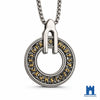
The pendant is a broad circular disc with the 24 Elder Futhark runes arranged around the face, each one clearly defined, with a central design bringing the whole composition together. The proportions are generous: this is a statement piece, not a discreet one. It is designed to be noticed.
Suited to anyone who prefers a piece with visible presence
The HC approach to Norse jewellery is the same as our approach to history: tell the buyer what the evidence actually says, and trust them to find it interesting. The Elder Futhark runes were used across a wide span of the ancient Germanic and Scandinavian world. Some, like Tiwaz (named for the god Tyr, associated with justice and sacrifice), have well-documented interpretive traditions. Others are more uncertain. A pendant that carries all 24 is a piece for someone who wants the full alphabet, the complete set of forces, rather than a single symbol in isolation.
This is a confident choice for someone interested in runic history, Norse mythology, or Scandinavian heritage. It is also a straightforward gift for anyone who fits that description.
This piece is sourced to order and typically arrives within 10 days. Every order ships tracked to UK addresses, free of charge.
The Elder Futhark is the oldest known runic writing system, used by Germanic and Scandinavian peoples from approximately the second to the eighth century CE. It consists of 24 characters, each carrying a phonetic value and, in many traditions, an associated meaning or force. The name comes from the first six runes of the sequence: Fehu, Uruz, Thurisaz, Ansuz, Raidho, and Kenaz. Runes appeared on a wide range of objects across the Viking Age and earlier, including weapons, memorial stones, and personal amulets. Scholars continue to debate the extent to which individual runes were used for magical or protective purposes, but their significance beyond simple writing is well-attested in the archaeological and literary record.
The pendant is made in stainless steel with a gold tone or silver tone finish. Stainless steel is corrosion-resistant and does not tarnish under normal wear. The gold and silver tones are durable finishes that hold up to daily use. Wipe clean with a soft dry cloth and store separately to prevent surface scratching.
This pendant is sourced to order and typically arrives within 10 days of purchase. Delivery to UK addresses is free and every order ships tracked. If you are ordering as a gift, that window gives you time to plan the occasion.
Yes. The Elder Futhark is a well-recognised symbol set for anyone interested in Norse history, Viking culture, or runic writing. The pendant's size and visual presence make it a piece that reads immediately as considered rather than casual. It is suited to gifting for birthdays, milestones, or for anyone with a known interest in Scandinavian heritage.