Your cart is empty
Tax included and shipping calculated at checkout

Cart Error
Drawer menu
Your cart (0)
Tax included and shipping calculated at checkout
Inspired by the events behind the upcoming film The Uprising, releasing on 11 September? Go beyond the big screen and uncover the extraordinary true story that changed medieval England forever.
Sign up today and instantly receive our beautifully illustrated Peasants' Revolt (1381) Infographic packed with fascinating facts, key figures, major battles, and the lasting legacy of one of history's most dramatic rebellions.
Enter your email below to get your FREE infographic instantly.



Ensure the paper is snug but comfortable, and passes over your knuckle.
Use the size guide below to find your perfect fit:
|
Circumference (mm) |
Size |
|
44 |
3 |
|
46 |
3.75 |
|
48 |
4.5 |
|
50 |
5 |
|
51 |
5.5 |
|
52 |
6 |
|
53 |
6.5 |
|
54 |
7 |
|
55 |
7.25 |
|
56 |
7.5 |
|
57 |
8 |
|
58 |
8.5 |
|
59 |
8.75 |
|
60 |
9 |
|
62 |
10 |
Celtic knotwork has no gaps and no ends. Every strand crosses over and under its neighbour and returns to where it began, creating a pattern that, read carefully, is a single continuous line. Stonecutters used it on grave markers and high crosses from Ireland to Northumbria from the seventh century onward. Manuscript illuminators worked it into the borders and initial letters of books that took years to complete. Jewellers pressed it into bronze and silver for patrons who understood that the interlacing was not merely decorative but carried the idea of continuity, of things that do not break.
That tradition is what this pendant draws on.
The pendant
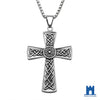
Celtic knotwork fills each arm of the cross in raised relief, the interlocking strands running from the shoulder of each arm to its tip without interruption. At the intersection of the arms, a circular medallion carries a tighter spiral knotwork pattern at a smaller scale. The contrast between the raised silver detail and the darkened ground gives every section of the design its own visual depth. The whole piece is cast in silver tone stainless steel on a polished box link chain.
There is no enamel and no colour detail. The design works entirely through the geometry of the knotwork and the contrast of the oxidised finish, which is why it holds up at the scale of a pendant better than busier pieces that lose their clarity when worn.
Built for regular wear
Stainless steel holds its finish without tarnishing. The knotwork detail, being cast rather than engraved, will not wear smooth with daily use. No maintenance required beyond an occasional wipe with a cloth.
For anyone interested in Celtic art, early medieval British and Irish decorative tradition, or heritage jewellery with genuine historical roots, this pendant is a considered piece.
This pendant is inspired by historical design elements and early medieval decorative tradition. It is not an authentic artefact and does not claim any affiliation with historical organisations, religious groups, or orders.
Materials Stainless steel with darkened oxidised relief finish. Celtic knotwork throughout. Spiral knotwork centre medallion. Silver tone. Polished box link chain.
Care Instructions