Your cart is empty
Tax included and shipping calculated at checkout

Cart Error
Drawer menu
Your cart (0)
Tax included and shipping calculated at checkout



Ensure the paper is snug but comfortable, and passes over your knuckle.
Use the size guide below to find your perfect fit:
|
Circumference (mm) |
Size |
|
44 |
3 |
|
46 |
3.75 |
|
48 |
4.5 |
|
50 |
5 |
|
51 |
5.5 |
|
52 |
6 |
|
53 |
6.5 |
|
54 |
7 |
|
55 |
7.25 |
|
56 |
7.5 |
|
57 |
8 |
|
58 |
8.5 |
|
59 |
8.75 |
|
60 |
9 |
|
62 |
10 |
In the Viking Age, the axe was not the weapon of last resort. It was the weapon of choice. Cheaper to produce than a sword, faster to learn, and capable of dealing devastating force in the confined press of a shield wall, the bearded axe was carried by warriors from Norway to the gates of Constantinople. It was also a tool, a marker of status, and an object passed between generations. When a Viking buried his axe with a man, it was not for sentiment. It was because the weapon would be needed on the other side.
This pendant carries both axes at once.
What the pendant shows
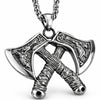
The two bearded axe heads cross at the centre and are cast as one piece, each facing outward. The face of each head is engraved with raised Norse animal figures, likely referencing the Urnes style beast interlace found on Viking Age runestones and metalwork across Scandinavia. Scroll and knotwork detail runs along the upper edge of each head. The handles are textured in a wrapped grip pattern down to the pommel ends, each set with a dark inlay. The whole surface has an oxidised silver finish, the recessed areas darkened to throw the raised engraving into sharp relief.
The pendant hangs on a polished wheat link chain that contrasts cleanly with the darker finish of the pendant itself.
Cast in 316L surgical grade stainless steel throughout. Tarnish resistant, corrosion resistant, and built to wear without maintenance.
For the right person, no context needed
For anyone with a serious interest in Viking history, Norse craftsmanship, or the material culture of the early medieval north, this pendant is a specific and considered gift. The level of engraving detail rewards a close look.
Materials 316L surgical grade stainless steel. Oxidised antique silver finish. Dark stone or resin inlays at pommel ends. Polished wheat link chain. Tarnish resistant and corrosion resistant.
Care Instructions